
Brass Hex Rod Uses in Various Applications and Their Benefits
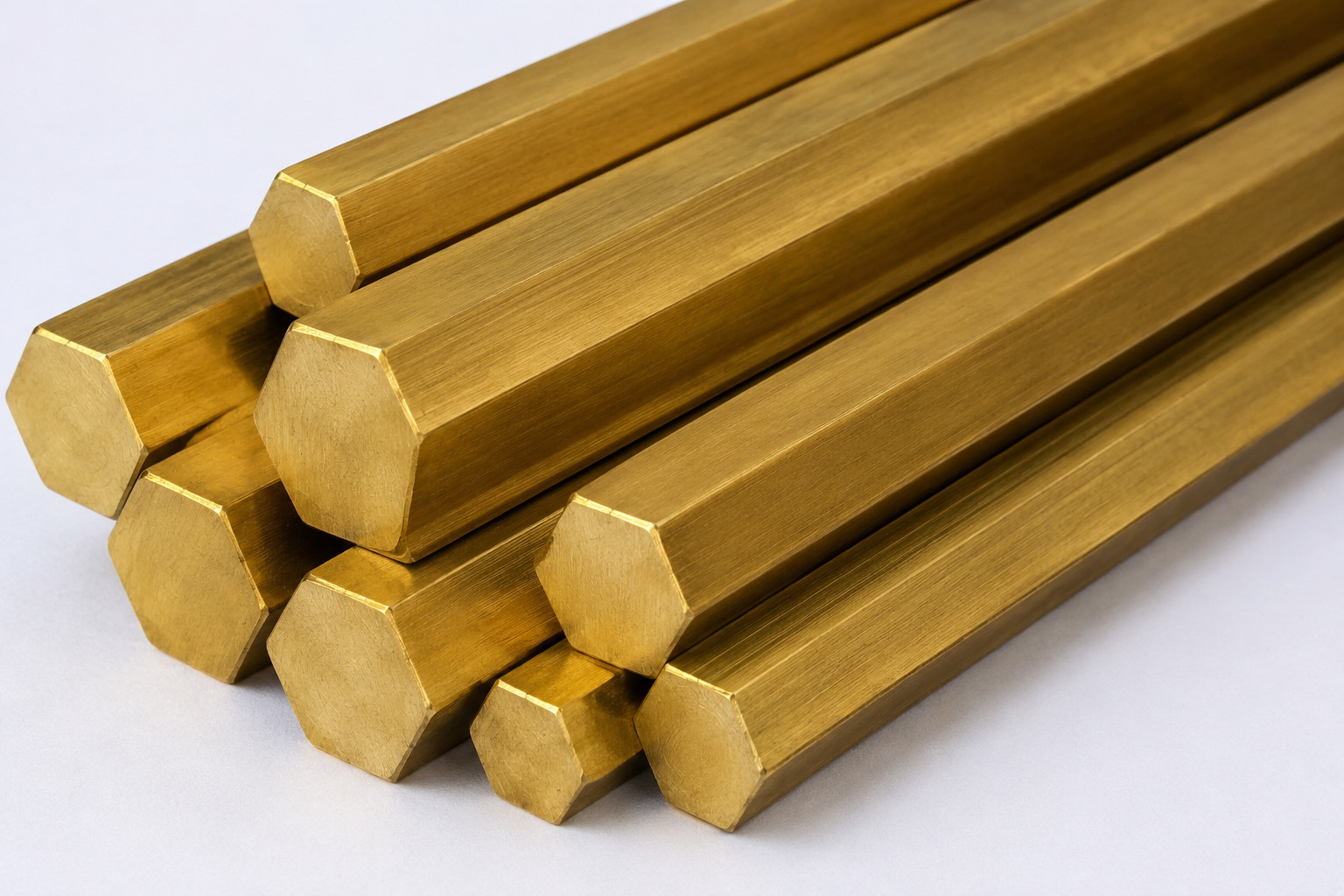
When choosing a brass rod, the alloy is important, but so is the shape.
Round rods work well for many general machining applications, while square and flat profiles have their own advantages. But when a component eventually needs flat sides, secure tool engagement, or a hexagonal finished profile, starting with a brass hex rod can make manufacturing considerably more practical.
Combined with brass’s machinability, strength, corrosion resistance, and versatility, the six-sided profile makes brass hex rods particularly useful for fasteners, fittings, valves, electrical parts, and precision-machined components.
Why Choose a Hexagonal Brass Rod?
One of the primary benefits of brass hex rod stock is that the raw material is already closer to the final shape of the component.
Think about a nut, fitting, adaptor, valve component, or connector. If it requires external flat surfaces for gripping or tightening, machining the entire profile from round stock means removing additional material.
Starting with hexagonal stock can reduce unnecessary machining for suitable components while providing six ready-made flats for tool engagement. This makes brass hex rods particularly practical for precision manufacturing, where machining efficiency and repeatability matter.
Quick Look: Where Are Brass Hex Rods Used?
| Application | Why Brass Hex Rods Work Well |
| Fasteners & Nuts | Hex profile provides natural flats for tightening and tool engagement |
| Valves & Fittings | Combines machinability with useful corrosion resistance |
| Electrical Components | Suitable for machined connectors and related components where the selected alloy meets performance needs |
| Plumbing Components | Well suited to many fittings, adaptors, and valve parts |
| Precision Components | Can be efficiently cut, drilled, threaded, and machined into detailed parts |
| Industrial Hardware | Ideal in applications that demand strength, machinability, and secure tool engagement |
More Than Shape: The Benefits of Brass Itself
The hexagonal profile adds manufacturing convenience, but the material properties of brass are what make these rods useful across such a wide range of industries.
Excellent Machinability
Suitable brass grades can be machined efficiently into detailed components with controlled dimensions and good surface finishes. Free-machining brass grades are particularly valued for high-volume production.
Good Corrosion Resistance
Brass provides useful corrosion resistance for its environment, and the appropriate alloy will be useful for plumbing parts, valves, and other industrial components.
Strength with Workability
Brass provides a useful combination of mechanical strength and workability in order to manufacture complex components.
Recyclability
Brass can be recycled, while machining scrap retains material value – an important consideration when producing components at scale.
The Right Brass Grade Still Matters
A hexagonal profile alone doesn’t determine how a rod will perform.
Different brass compositions offer different balances of machinability, strength, ductility, and corrosion resistance. For example, free-machining brasses are particularly useful where extensive cutting, drilling, or threading is required, while other compositions may be selected when forming characteristics or service-environment performance take priority.
In other words, the first consideration should not be just: “Do I need a brass hex rod?” But rather: “Which brass grade best suits the component I’m manufacturing?”
The intended application, machining process, operating environment, dimensional tolerances, and relevant industry standards should all influence material selection.
When Does the Hex Profile Make the Most Sense?
Not every component needs to start with hexagonal stock. A brass hex rod becomes particularly valuable when the final component:
- Requires wrench or spanner flats
- Has a predominantly hexagonal external geometry
- Requires extensive drilling, threading, or machining
- Is manufactured repeatedly in larger quantities
- Needs consistent dimensions across production batches
In these applications, choosing a profile closer to the final geometry can help streamline subsequent manufacturing operations.
Final Thoughts
Even the best component designs cannot compensate for poor raw materials.
For accurate fabrication processes, along with sizes, purchasers should pay attention to the alloy content, tolerance, surface condition, relevant standards, and batch consistency.
The importance of this issue increases if one needs to process the brass hex rods into high-precision parts in big quantities since even small changes in material can affect subsequent manufacturing processes.
Sneh Metal Alloys provides brass bars in round, hexagonal, square and flat sections, as well as custom-shaped brass rods as per requirement. With brass rod sizes ranging from 4.00 mm to 90.0 mm and production aligned with standards including IS, BS, and EN, customers can source profiles according to their specific manufacturing requirements.
