
What Is Brass? Understanding the Copper-Zinc Alloy
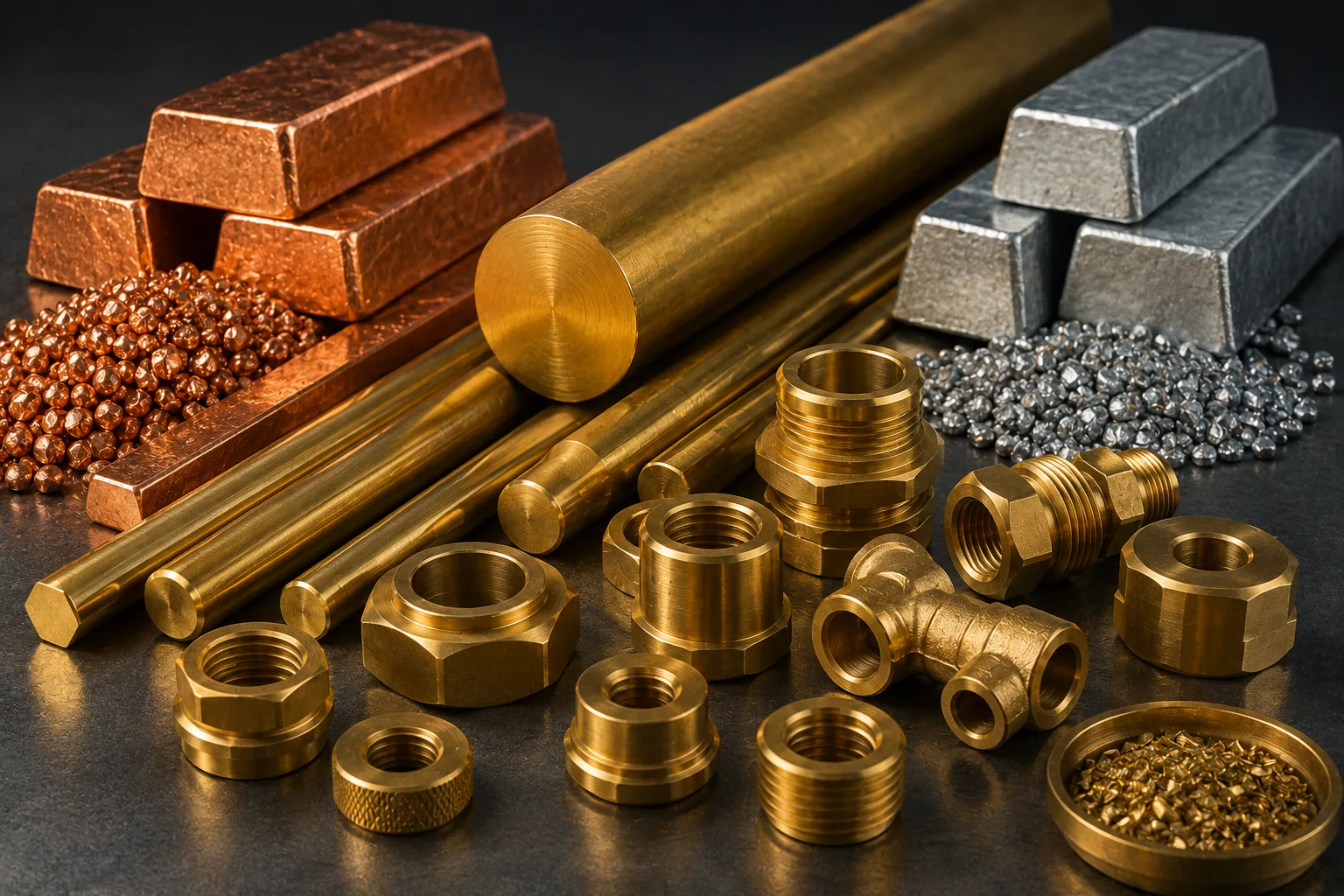
It is not very often that people ask the question: What is brass? However, when we speak of brass, there may be a variety of definitions and explanations to this term. In particular, brass can be defined as an extremely widespread engineering material whose application covers numerous fields such as oil and gas or the automotive industry. Nevertheless, why is brass so popular and useful?
What Is Brass? A Concise Definition
Brass is a metallic alloy that is mainly made up of two elements: copper (Cu) and zinc (Zn). An alloy is not a chemical compound, which means its components are mixed physically and therefore its ratios can be customized for desired properties. Brass usually consists of 60% to 90% of copper and zinc as the rest of the alloy. This customizability is exactly what makes brass suitable for a vast number of industrial purposes.
How Copper-to-Zinc Ratio Shapes Brass
The composition of brass directly determines its behaviour. Higher copper content improves corrosion resistance and electrical conductivity. Increasing zinc content enhances strength and machinability which makes the metal easier to cut, drill, and machine into precision turned components.
The most common industrial grades include:
| Grade | Copper % | Zinc % | Best Known For |
|---|---|---|---|
| IS-319 / CZ-121 (Free Cutting Brass) | 57-59% | 39-41% | Exceptional machinability |
| CA360 (Free Machining Brass) | 60-63% | 35-38% | High-speed precision turning |
| CA377 | 59-62% | 36-40% | Forging and fittings |
| Cartridge Brass (70/30) | 70% | 30% | Deep drawing, forming |
Free cutting brass, particularly IS-319 and CZ-121, is the preferred grade for manufacturing precision components because it produces clean, short chips during machining, extends tool life, and holds tight dimensional tolerances. If you are selecting brass for a specific application, choosing the right brass grade plays a major role in ensuring durability and performance.
Properties Making Brass Suitable for Use in Engineering
Brass has been selected by engineers and procurement officers due to a combination of factors which few other materials possess:
- Highly machineable – it machines faster than steel, with lower tool wear.
- Corrosion resistant – particularly to water, oil, and gases.
- Does not spark – essential in flammable or explosive environments.
- Highly conductive – thermal and electrically.
- Low friction – great for moving parts.
- Recyclable – 100% recyclable, without any loss of properties.
Where Brass Components Are Used
High precision brass components play a key role in many important industries including:
- Oil and Gas industry – fittings, valves, and connectors for high-pressure and corrosive media.
- Automobiles – brake systems parts, fuel line fittings, and grease nipples.
- Water purification – pipe and compression fittings to resist corrosion by water.
- Electronics and Electrical – terminals and inserts for good electrical conductivity.
The Bottom Line
Brass is a combination of copper and zinc, however, by varying their ratio, one can get drastically varied characteristics in this metal. There is no other metal having such a unique set of features as machinability, resistance to corrosion, conductivity and safety. It is because of these qualities brass is the preferred metal for making various industrial components across the globe.
At Sneh Metals, we manufacture precision brass components using high-quality brass grades for industries across the globe. Being located in Jamnagar, which is considered the brass capital of India, we manufacture a wide range of brass components with a strong focus quality, and reliability.
When material quality and machining precision matter, the alloy matters. And brass, the right brass, in the right grade makes all the difference.
Ready to source precision brass components for your industry? Explore our product range or contact the team at Sneh Metals for a quote.
